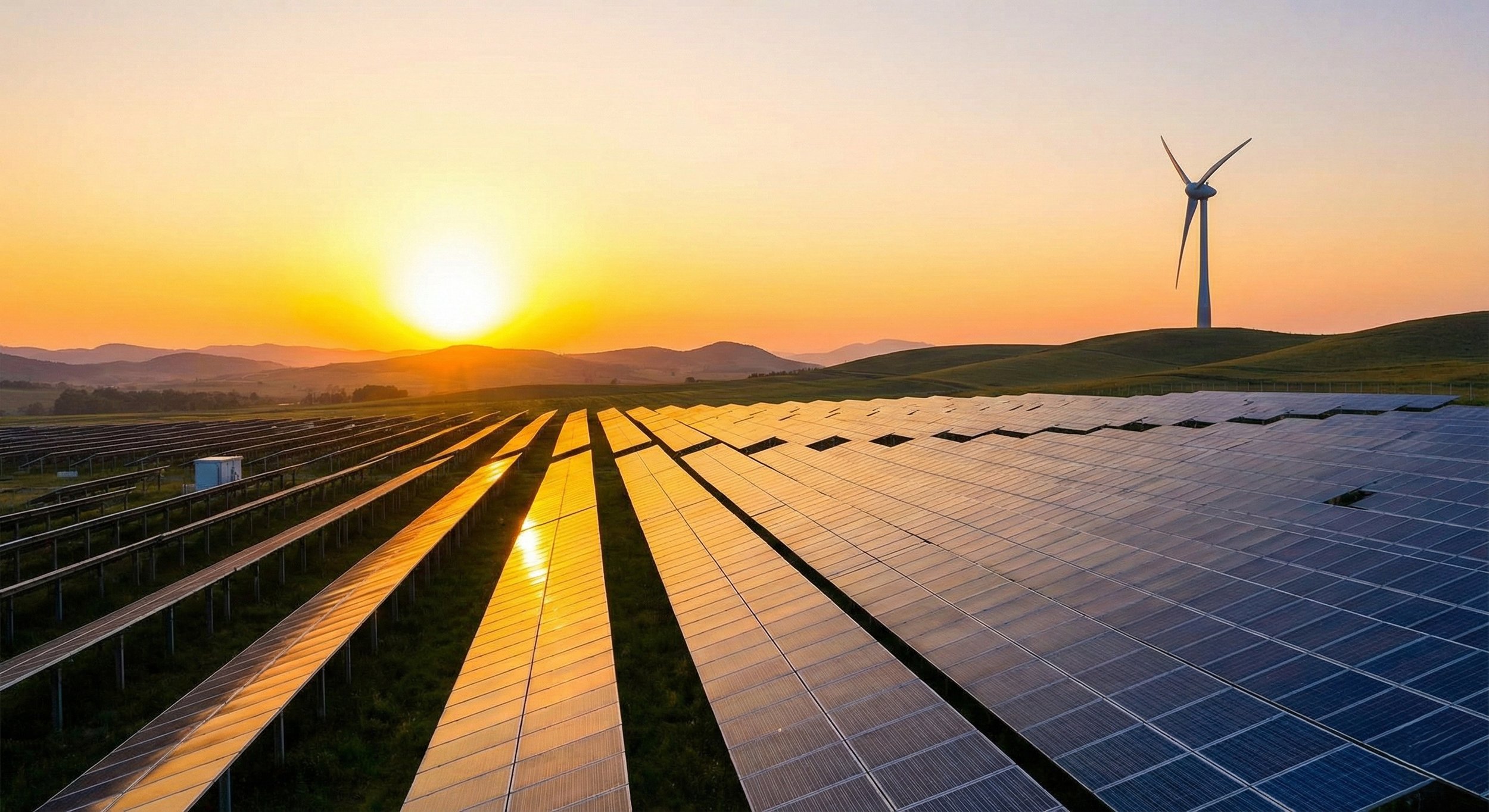
FROM FARMLAND TO SOLAR FARM
Balancing Landowner Relations and Renewable Development
Solar development often looks straightforward from the outside. Find flat ground. Stay near transmission. Avoid wetlands. Lock up acreage.
In the field, it is rarely that simple.
When farmland becomes a solar site, the project is not just changing land use. It is intersecting with livelihoods, family history, seasonal rhythms, and long-held assumptions about what that land is for. How those realities are handled early often determines whether a project moves smoothly or grinds forward under constant friction.
For many developers, the technical work is familiar. The human work is where things get complicated.
FARMLAND IS NOT VACANT LAND
One of the most common mistakes in early solar siting is treating farmland as idle or underutilized. In practice, working land is almost always deeply optimized already, even if it does not look that way on a map.
Fields rotate. Drainage patterns matter. Access lanes are used differently during planting and harvest. Leases may be informal but binding in practice. A single misplaced fence or access road can disrupt operations for years.
Landowners know this instinctively. They also know when a development team does not.
Early conversations that gloss over how farming actually works tend to raise alarms. Not because landowners are opposed to solar, but because they have seen what happens when outside parties underestimate the complexity of their ground.
In the field, credibility starts with acknowledging that farmland works just fine as it is.
SOLAR TIMELINES COLLIDE WITH AGRICULTURAL CYCLES
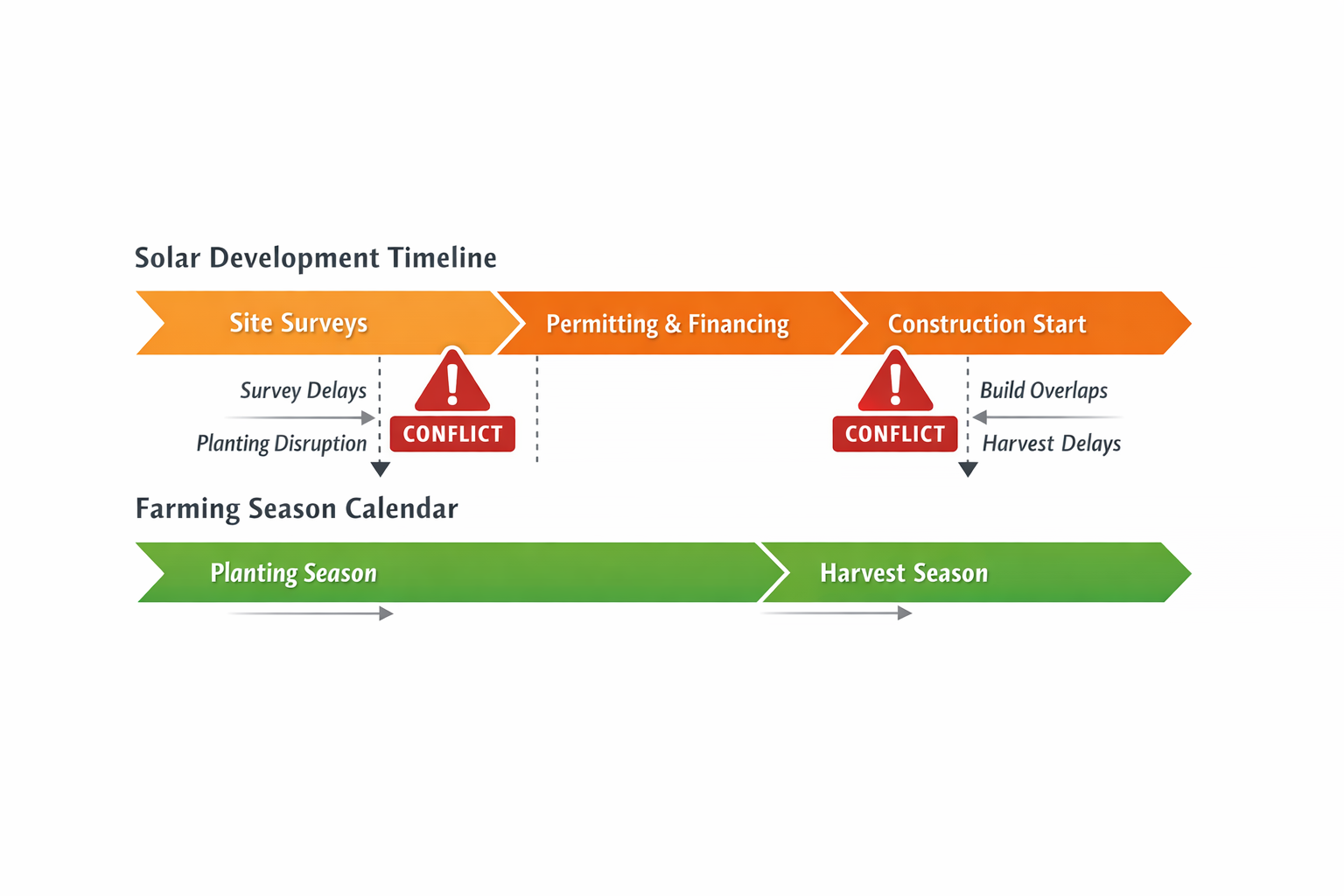
Solar development timelines are driven by interconnection windows, equipment procurement, and financing milestones. Agriculture moves to a different clock.
Planting does not wait for surveys. Harvest does not pause for geotech. Weather compresses windows that cannot be recovered later.
When these timelines collide without coordination, frustration follows quickly.
Experienced land agents learn to translate between these two systems. They know when a request that sounds small to a developer is a major disruption to a farmer. They also know when flexibility is possible, and when it is not.
The projects that succeed are the ones that treat the farming calendar as a fixed constraint, not an inconvenience to manage later.
A FAMILIAR FIELD STORY
A solar developer identifies a large tract of row crop ground near a substation. The site checks every technical box.
The initial outreach is positive. The landowner is open to the idea and interested in diversification. An option is signed quickly.
Then fieldwork ramps up.
Survey crews arrive during planting without notice. Stakes interfere with equipment. A temporary access road cuts across a drainage swale. The farmer raises concerns, but responses are slow because the development team is juggling multiple priorities.
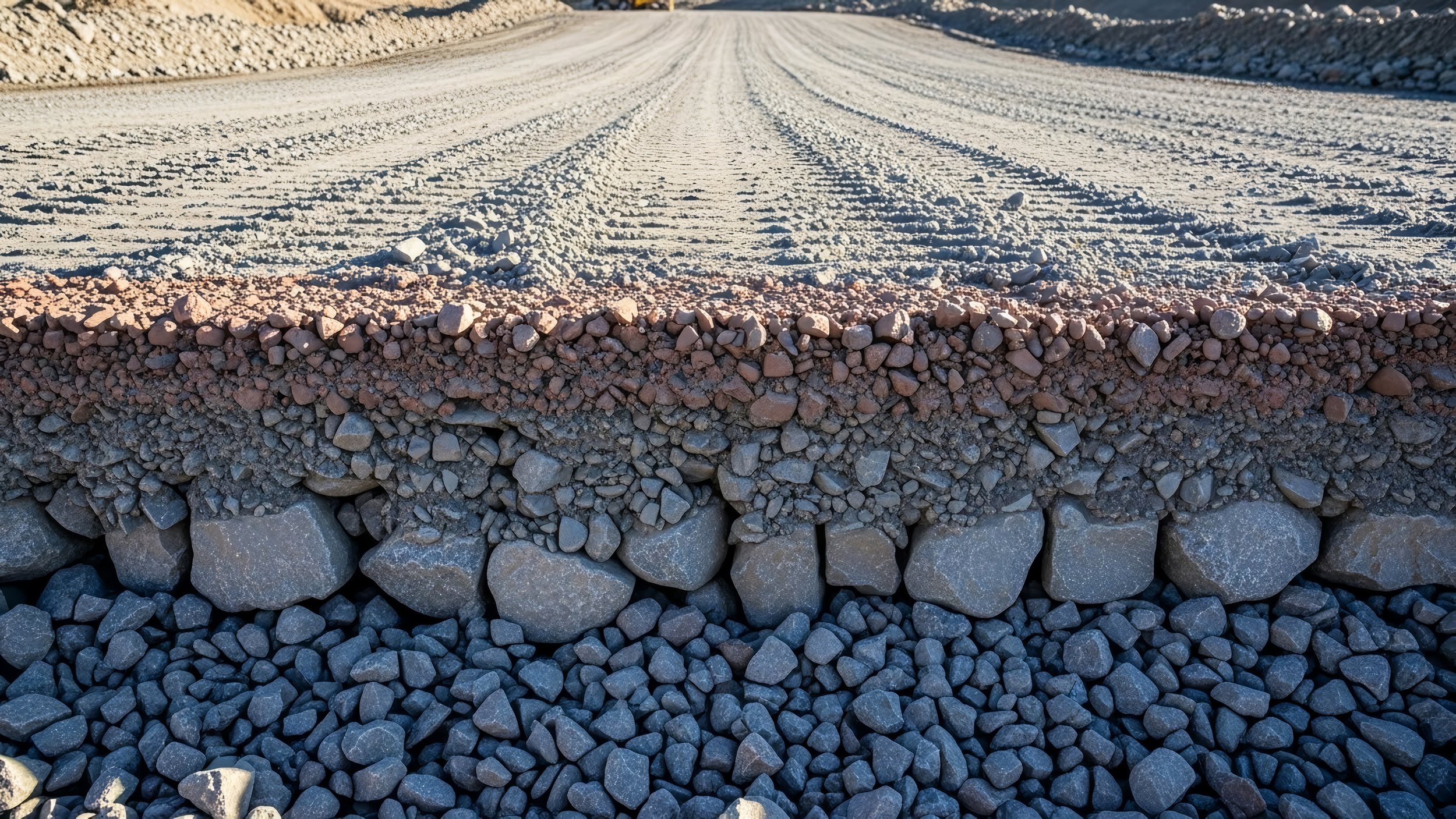
Nothing catastrophic happens. But irritation builds.
By the time construction planning begins, the landowner is no longer enthusiastic. They scrutinize every request. They question restoration commitments. They involve neighbors and advisors who were previously neutral.
Contrast that with a different approach.
Before the option is signed, the land agent walks the field with the landowner. They talk through crop rotation and drainage. They flag sensitive areas and discuss what construction would realistically look like. They set clear expectations about what will change and what will not.
When fieldwork begins, it is coordinated around the farming calendar. Issues still arise, but they are addressed quickly and directly.
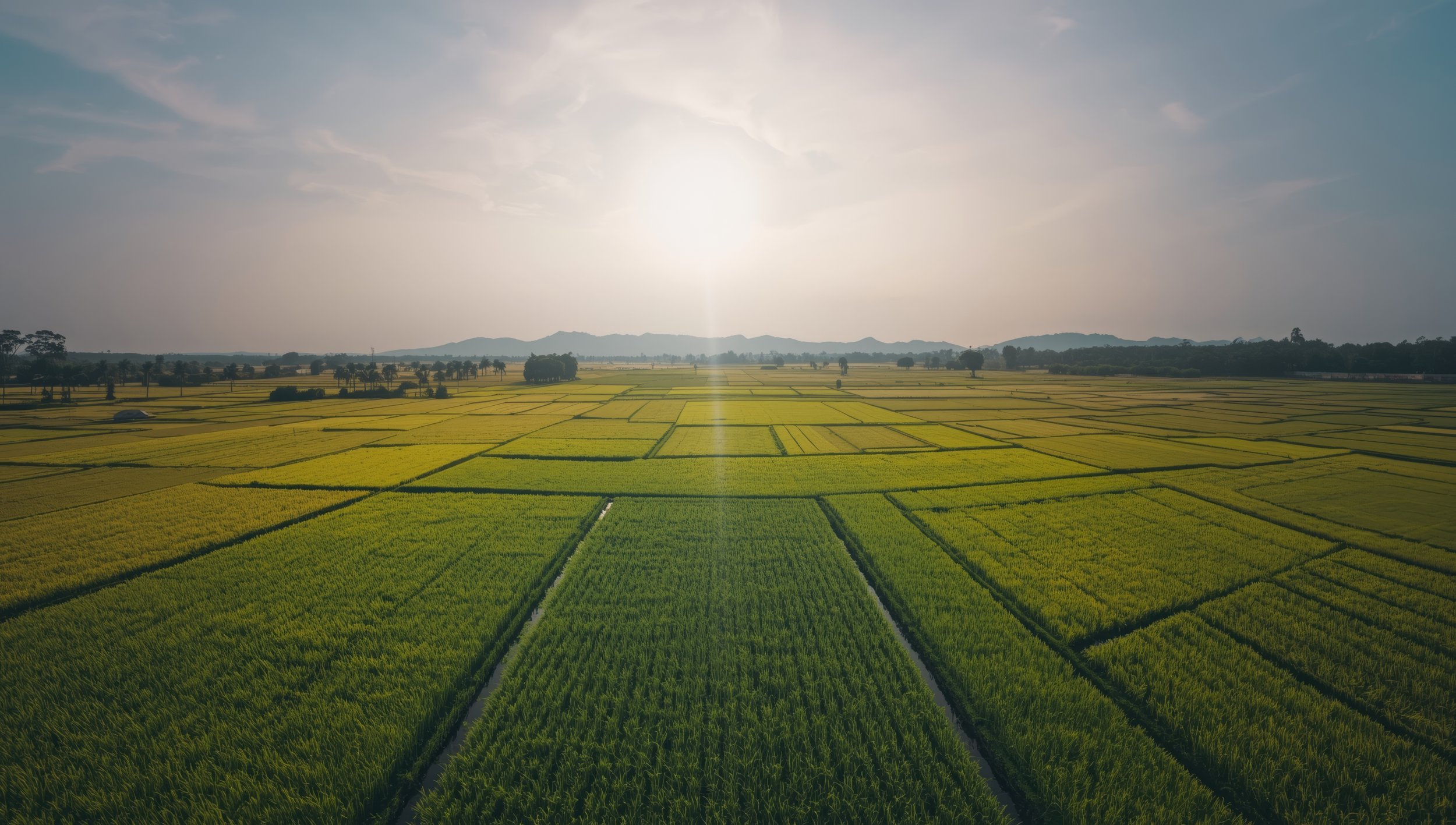
The land is the same. The difference is how early respect was demonstrated.
RESTORATION IS NOT A FOOTNOTE
For farmland solar projects, restoration is often where trust is either cemented or lost.
Promises about soil structure, compaction mitigation, and post-construction productivity carry more weight than lease rates. Farmers think in decades. They know what damaged soil looks like years after a contractor leaves.
Vague assurances undermine confidence. Specific plans build it.
Land agents who succeed in these environments are precise. They talk about topsoil segregation, subgrade handling, and decompaction. They explain who is responsible and how issues will be addressed if yields change.
Most importantly, they follow through.
In the field, restoration performance becomes reputation quickly. One poorly restored project can influence an entire community’s view of solar development.
BALANCING PROGRESS AND PERMANENCE
Solar projects are long-lived. For farmers, that permanence cuts both ways.
Some see stability and predictable income. Others worry about loss of flexibility, generational transition, and what happens when the project ends.
Those concerns do not disappear with better economics.
Long-term success requires acknowledging that a solar lease is not just a financial instrument. It is a land use decision that reshapes how a family thinks about its property for decades.
Land agents who understand this do not rush to close. They make space for questions. They revisit topics over time. They ensure that what is written on paper matches what has been said in person.
When expectations are aligned early, resistance later is far less likely.
THE LESSON DEVELOPERS OFTEN LEARN TOO LATE

Solar development on farmland is not a trade between clean energy and agriculture. It is a negotiation between two systems that both care deeply about land.
The projects that struggle tend to assume alignment instead of earning it. They treat landowner relations as a phase instead of an ongoing obligation.
From the field perspective, the lesson is clear. Solar projects move faster and face fewer challenges when landowners feel respected, informed, and confident that their land will be treated well during and after construction.

FIELD NOTES
• Acknowledge existing land use early. Farmers know when their operations are being underestimated.
• Coordinate with the agricultural calendar. Planting and harvest are fixed constraints, not suggestions.
• Be specific about restoration. Clear plans and accountability matter more than broad assurances.
• Communicate consistently. Mixed messages erode trust quickly in rural communities.
• Think beyond the option term. Long-term land use impacts shape landowner decisions today.
Farmland has always been shaped by long horizons. Solar development brings new opportunity, but also new responsibility.
When renewable projects respect how land is lived on and worked, they are far more likely to be welcomed and sustained. When they do not, resistance is rarely loud at first, but it is persistent.
Balancing farmland and solar development is not about choosing sides. It is about doing the field work well enough that both can coexist with credibility intact.
Next time, we will look at how early restoration commitments influence landowner trust long before construction ever begins.